A member finishes a heavy set of squats, walks toward the water station, and collapses. Within seconds the mood on the gym floor changes. Some people freeze, others reach for their phones, and a few look around for someone who knows what to do.
Sudden cardiac arrest is uncommon in fitness settings, but it is not rare enough to ignore. A facility that serves hundreds of members each week will eventually encounter one. What happens in the first few minutes usually decides the outcome, and that comes down to preparation.
Why Fitness Facilities Carry Particular Risk
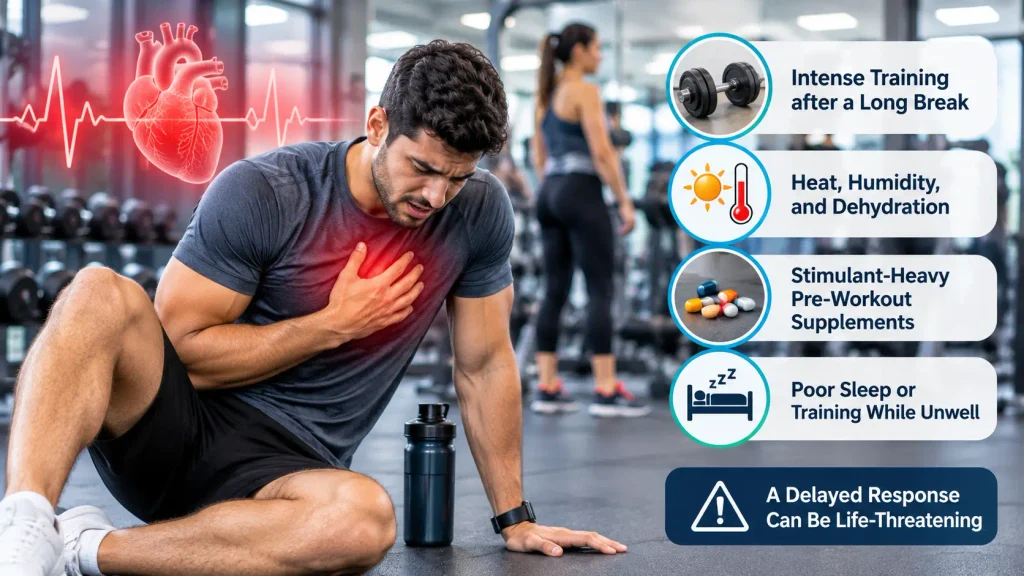
Exercise puts real demand on the heart. For most healthy people. For someone with an undiagnosed rhythm problem or a weakened heart muscle, hard effort can be the trigger. Several everyday factors add to the strain:
- Intense training after a long break from exercise
- Heat, humidity, and dehydration
- Stimulant-heavy pre-workout supplements
- Poor sleep or training while unwell
Gyms also have a practical weakness. Staff are spread between reception, the floor, and group classes, and members often train alone with headphones on. A collapse can go unnoticed for a minute or more, and that delay costs the most.
The First Five Minutes
Without defibrillation, the chance of survival falls with every minute that passes. Staff should be able to follow a set order without stopping to think:
- Recognize it: A person who is unresponsive and not breathing normally, or only gasping, should be treated as a cardiac arrest.
- Call for help: One person phones emergency services (998 for an ambulance in the UAE) while another fetches the AED. Give these jobs to people by name. “Someone call an ambulance” rarely works.
- Start CPR at once: Firm, fast compressions in the center of the chest keep blood flowing to the brain.
- Use the AED: Switch it on, attach the pads, and follow the voice prompts. It will only deliver a shock if one is needed.
- Keep going: Continue until paramedics take over or the person shows clear signs of life.
Equipment and Layout
An AED locked in a back office, or one with a flat battery, offers no protection. A good guide is that a trained responder should be able to reach the device and return to the casualty within about three minutes. In larger sites, that usually means more than one unit.
Pay attention to these points:
- Mount AEDs in visible, unlocked cabinets near the training floor, studios, and changing areas
- Add clear signage so a first-time visitor can find them.
- Check pads and batteries on a fixed schedule and log every check.
- Keep gloves, a pocket mask, a towel, and trauma shears beside the device.
- Make sure a stretcher can pass through entrances and turnstiles.
Pools need extra care, because a swimmer in trouble in the water can look much like one having a cardiac event. Pool staff need specialist lifeguard training in Dubai that covers water rescue as well as resuscitation.
Training the Team
Equipment is only half the answer. Staff need training they can recall under stress, and that means hands-on practice with manikins and a trainer AED, not a video and a signature.
Personal trainers deserve particular attention. They work one-to-one with members, push them physically, and are often the first to notice that something is wrong. A course such as First Aid for Personal Trainers covers CPR, AED use, and the situations they meet most often on the gym floor.
When choosing a provider, look at the accreditation behind the certificate. HSS has over 14 years of experience in the UAE and GCC. Its programs run through recognized bodies:
- Health and Safety Institute (HSI)
- American Safety and Health Institute (ASHI)
- Highfield Awarding Body for Compliance (HABC)
- Local approvals, including the Dubai Health Authority and KHDA
That mix of international and local approval gives operators confidence that their staff are trained to a recognized standard.
Rehearse, Review, Refresh
Skills fade. Many first aiders feel less sure about compressions within months of a course, which is why certificates expire. Build refreshers into the staffing plan rather than waiting for the renewal date.
A few habits make a real difference:
- Run a short mock-collapse drill every quarter, in a different area each time
- Hold a ten-minute debrief afterwards to find gaps.
- Keep a written emergency action plan that every employee understands, including cleaners, reception, and part-time instructors.
- After any real incident, record what happened, download the AED data, and support the staff involved.
Witnessing a cardiac arrest is distressing, even when the response goes well.
Screening and Member Awareness
Facilities cannot prevent every cardiac event, but they can lower the risk. A simple health questionnaire at sign-up helps identify members who should see a doctor before they start. Encourage newcomers to build up gradually and to tell staff about chest pain, unusual breathlessness, or dizziness instead of pushing through. A culture where people feel comfortable stopping mid-session is a safer one.
Final Thoughts
A cardiac emergency is the situation every fitness operator hopes never to face and should always be ready for. Early recognition, immediate CPR, and a defibrillator within reach give a member the best chance of leaving hospital alive. Reliable equipment, a trained and regularly refreshed team, and a plan that has actually been rehearsed make that response possible.
If your facility has not reviewed its readiness recently, start with an honest audit of AEDs, staff certifications, and response procedures. Then browse the full course list to find training that fits your team.